

What Actually Goes Into Pricing a Custom Home?
One of the first questions people ask when they start thinking about building a custom home is simple:
“What does it cost?”
It’s a fair question. It’s also not always a simple one to answer well.
A custom home is not priced like a product on a shelf. There is no single number that works for every house, every lot, every plan, or every level of finish. A real price depends on what is being built, where it is being built, how it is being built, and what level of detail the homeowner expects when it is finished.
That does not mean the early conversation has to be confusing. It just means the number needs context.
Here are a few of the biggest things that shape the price of a custom home.
The plan itself
The floor plan is one of the biggest drivers of cost, but not just because of square footage.
Two homes can have the same finished square footage and still be very different builds. One may be simple and efficient. The other may have taller ceilings, more corners, larger porches, a more complicated roofline, more windows, custom trim details, or a layout that requires more structure.
Those details matter.
A house with a clean rectangular footprint will usually price differently than a house with multiple wings, deep porches, several roof transitions, and a more detailed exterior. That does not mean one is better than the other. It just means they are not the same project.
This is why early pricing based only on finished square footage can be misleading. Finished square footage is important, but it does not tell the full story.
Finished square footage vs. under roof square footage
Most homeowners talk about finished square footage. Builders look at that number too, but we also pay close attention to total square footage under roof.
That includes areas like porches, garages, covered patios, walk-in storage, unfinished spaces, and other parts of the structure that may not be counted as heated living area.
Those areas still have cost. They may need foundation, framing, roofing, trim, concrete, columns, lighting, paint, and other materials. They may not be “finished square footage,” but they are still very much part of the house.
For example, a 3,000-square-foot home with a small garage and minimal porch space is very different from a 3,000-square-foot home with a large garage, deep front and rear porches, outdoor living space, and significant storage under roof.
From the street, and on paper, both may sound like “3,000 square feet.”
From a building standpoint, they are not the same.
The level of finish
Finish level is another major factor.
Cabinetry, countertops, appliances, flooring, plumbing fixtures, lighting, tile, trim, doors, hardware, and exterior materials can all move the budget. Sometimes by a little. Sometimes by a lot.
A home can be well-built and still have a more restrained finish package. Another home may have custom cabinetry throughout, taller doors, detailed trim, higher-end appliances, specialty lighting, upgraded windows, and more involved tile work.
Both can be good homes. But they will not be priced the same.
This is one of the reasons vague words like “nice” or “high-end” are not specific enough during the pricing process. One person’s version of “nice” may be very different from another person’s.
The clearer the expectations are, the more useful the pricing conversation becomes.
Building science and performance
Not every cost is something you immediately see when you walk through the front door.
Some of the most important parts of a home are behind the walls, under the floors, above the ceiling, or inside the mechanical system.
In eastern North Carolina, that matters. Heat, humidity, rain, and moisture are real parts of the building environment here. The way a home is framed, sealed, insulated, ventilated, conditioned, and protected from moisture has a long-term effect on comfort, durability, indoor air quality, and maintenance.
A better-built home may include things like stronger air sealing, better moisture management, a sealed and conditioned crawlspace, improved ventilation, upgraded HVAC design, higher-performing windows, or a more complete approach to the building envelope.
Those details may not be as exciting to talk about as countertops or paint colors, but they matter a lot once you live in the home.
They also affect price.
When comparing builders or early estimates, it is worth asking what is actually included behind the walls. A lower number is not always a better number if it leaves out the things that make the home more comfortable, durable, and efficient over time.
The foundation and structure
Foundation type can also make a major difference.
A slab foundation, traditional crawlspace, sealed crawlspace, raised foundation, or more complicated site condition can all change the cost. So can soil conditions, drainage, grading, driveway length, utility access, and the amount of site work needed before construction really begins.
The structure itself matters too.
Longer spans, taller ceilings, heavier loads, more complex roof framing, larger openings, and detailed porches can all require more labor, more material, or more coordination.
A custom home is not just the rooms you see on the plan. It is the structure required to make those rooms work.
A real example from Eagle Farm
A good example is right here in Wilson.
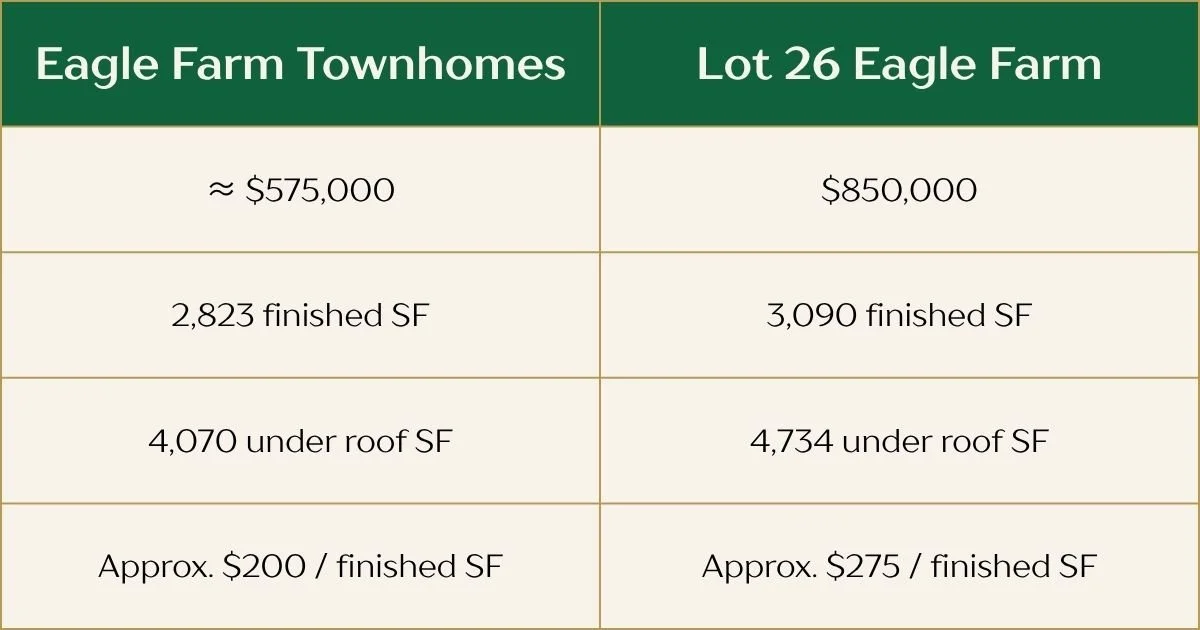
At first glance, someone might look at these homes and focus mostly on finished square footage. The townhomes were roughly 2,823 finished square feet, and Lot 26 Eagle Farm is roughly 3,090 finished square feet.
That is not a huge gap in finished square footage.
But finished square footage does not tell the whole story.
Lot 26 is a detached single-family home. It has more total square footage under roof, a higher finish level, taller ceilings and doors, a traditional foundation instead of a slab, more architectural presence, and a different overall level of detail.
The townhomes are still very nice homes. They were thoughtfully built and well-finished. But they are not the same product as Lot 26.
That is the point.
Square footage matters, but it is not the whole equation.
Why cost per square foot only goes so far
Cost per square foot can be useful as a rough reference point, but it becomes a problem when people treat it like the whole answer.
It does not fully account for plan complexity.
It does not explain finish level.
It does not show what is under roof.
It does not tell you what kind of foundation is included.
It does not tell you how the home is being sealed, insulated, ventilated, or conditioned.
It does not tell you what assumptions are being made.
A square foot number without context can make two very different homes look more similar than they really are.
That is why a responsible builder will usually want to know more before giving a serious pricing opinion. Not because they are trying to avoid the question, but because they are trying not to give an answer that falls apart later.
The best early pricing conversations have context
You do not need every selection made before you talk with a builder.
You do not need every detail solved.
But the conversation gets much more useful when there is clarity around the big things:
Where are you building?
What kind of plan are you considering?
How much square footage is finished, and how much is under roof?
What level of finish do you expect?
How important are comfort, efficiency, and long-term performance?
What kind of structure and foundation does the home require?
What budget range actually feels realistic?
Those questions help move the conversation from guessing to planning.
And that is really the goal.
A custom home is too personal, too detailed, and too important to price with a throwaway number. The goal is not just to get a number quickly. The goal is to understand what is driving that number, what choices matter most, and whether the home you are imagining lines up with the investment you are ready to make.
In our next post, we will talk about a better way to start the custom home budget conversation so the homeowner, builder, architect, and designer can work from the same page earlier in the process.
Still in the early planning stage? Download our Custom Home Planning Guide to think through the decisions that shape budget, design, comfort, and the building process before you get too far down the road.